Finance Periscope
Transfer fee amortisation: why a €50m signing costs €10m a year on the books
Clubs do not expense a transfer fee all at once. Understanding amortisation is the key to reading PSR, UEFA’s squad cost rule and “amortisation accounting” transfers.
Published 2026-11-02T16:11:40.777000Z · Updated 2026-11-02T16:11:40.777000Z
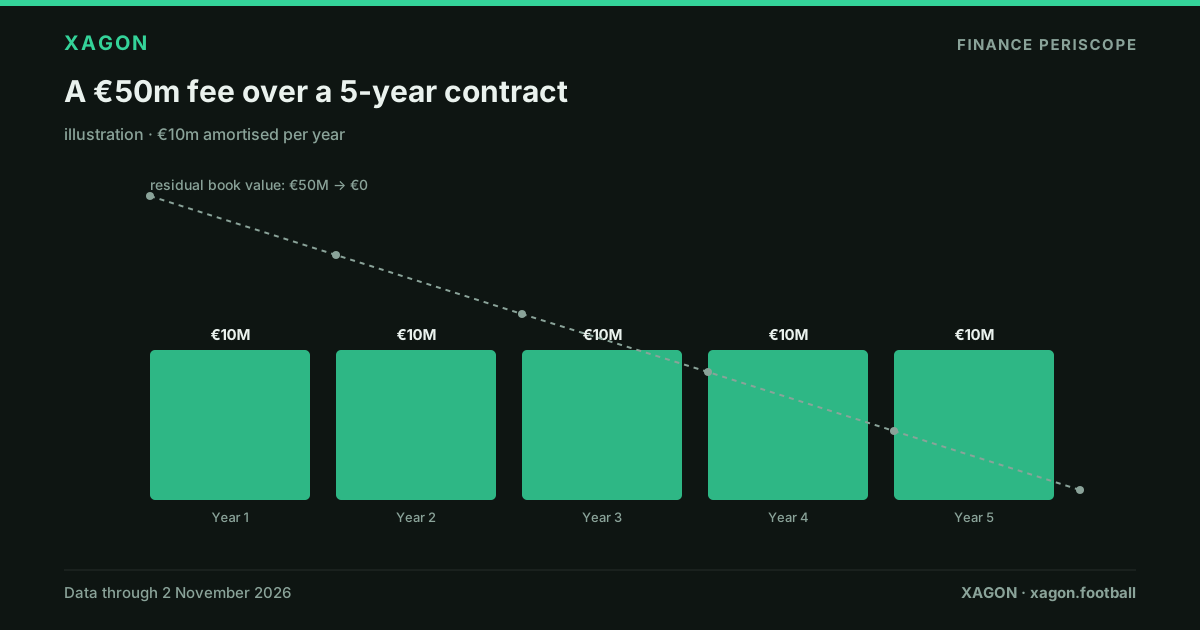
Amortisation spreads a transfer fee across the length of the player’s contract, so a €50m signing on a five-year deal appears as roughly €10m of cost in each of those years, not €50m in year one. The fee is treated as an intangible asset and written down over the contract. This single accounting rule explains most of what people find confusing about football finance.
Why it matters for the rules
Profit-and-sustainability tests look at costs, and amortisation is a cost. UEFA’s financial rules make this explicit: under the squad cost ratio, a club’s player wages plus the amortisation and impairment of player costs plus agent fees are measured against revenue, as set out in Article 93 of the UEFA Club Licensing and Financial Sustainability Regulations. The permitted ratio is being tightened to 70%.
How clubs use it
Longer contracts lower the annual charge — a reason some clubs signed players to very long deals. In published accounts, amortisation of players’ registrations is a named line: Manchester United, for example, reports it in its financial statements filed with the SEC. When a player is sold, the profit is the fee received minus the remaining book value, which is why selling an academy graduate (book value near zero) can show up as near-pure profit.
The XAGON view
Accounting book value is not market value. A player can be almost fully amortised on the books yet highly valuable in the market, or vice versa. XAGON’s value estimates are market-facing, with a published range, and are deliberately kept separate from accounting figures. Read the companion piece on UEFA’s squad cost rule and see current value estimates on Markets.