Football Markets
What it means that Manchester United is a listed company (NYSE: MANU)
A handful of football clubs trade on public stock exchanges. Here is how to read a club like Manchester United as a listed company — without confusing share price with sporting results.
Published 2026-11-02T16:11:40.777000Z · Updated 2026-11-02T16:11:40.777000Z
Manchester United plc trades on the New York Stock Exchange under the ticker MANU. Owning a share makes you a shareholder in the company that owns the club — a financial stake, not a say in team selection, and not the same thing as a fan token.
How the listing works
United listed in August 2012 at $14 per share, as its investor FAQ records. It uses a dual-class structure: publicly traded Class A shares and high-vote Class B shares. Per the company’s SEC filing, the Glazer family controlled about 67.9% of voting rights and INEOS about 28.9% as of December 2024. This is why a listed club can be “public” yet still founder-controlled.
What actually moves a football stock
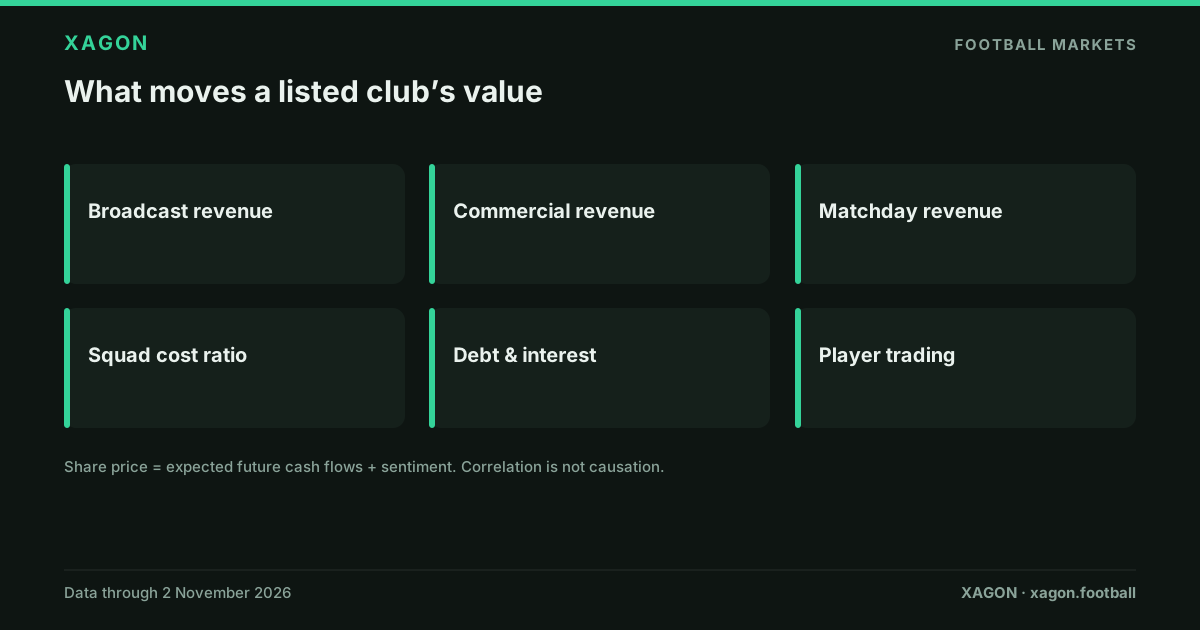
A club’s share price reflects expected future cash flows — broadcast, commercial and matchday revenue, the cost base, debt and player trading — filtered through market sentiment. Correlation is not causation: a share can fall on a day the team wins, or rise on a day it loses, because markets price many things at once. We do not claim a result “caused” a price move. For the cost side, see the squad cost rule.
The XAGON view
A listed club’s equity and XAGON’s player-value estimates are different objects: one is a claim on company profits, the other a model estimate of a transfer value. We keep them separate. This article is information and analysis only — it is not a recommendation to buy, sell or hold any security, and it is not a price target. Explore XAGON’s football value and strength layers on Markets and Indices.