Sport Periscope
How Elo ratings work in football — and why beating a stronger team matters more
A chess system from 1960 became football’s most intuitive strength measure. Here is the formula, in plain terms, and what the numbers can and cannot tell you.
Published 2026-11-02T16:11:40.777000Z · Updated 2026-11-02T16:11:40.777000Z
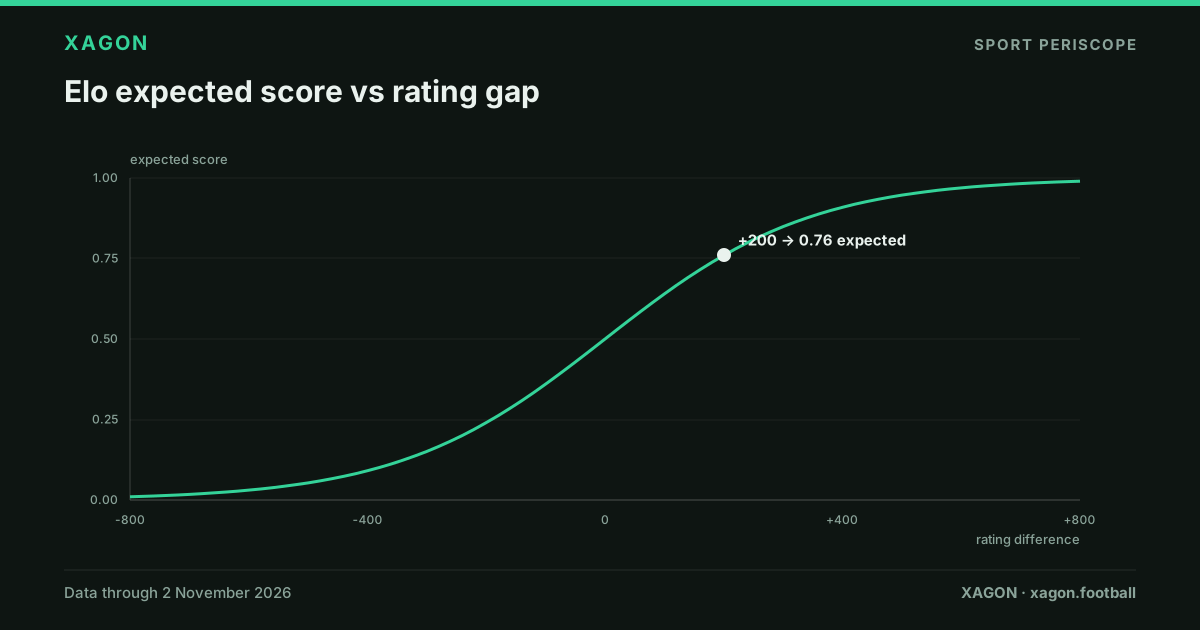
An Elo rating turns results into a single number for relative strength: you gain more for beating a stronger opponent than a weaker one, and the rating converges on a team’s true level over time. The system was created by Arpad Elo, a Hungarian-American physics professor, for chess. The United States Chess Federation adopted it in 1960 and the World Chess Federation (FIDE) in 1970, as documented in Elo’s book The Rating of Chessplayers.
The formula, in plain terms
A new rating is the old rating plus a correction: Rₙ = Rₒ + K×(W − Wₑ), where W is the actual result and Wₑ is the expected result from the rating gap. A 200-point advantage implies about a 0.76 expected score. If you do better than expected, your rating rises; worse, it falls. That is the whole intuition.
How football adapted it
Bob Runyan adapted Elo to international football in 1997, adding a weighting for match importance, an adjustment for home advantage, and an adjustment for goal difference, as the World Football Elo Ratings document. Club versions such as ClubElo apply the same logic to clubs. Ratings are considered reliable after roughly 30 matches; before that they are provisional.
The XAGON view
Elo’s strength is also its limit: it reads results, not underlying play, so a lucky win still moves it. XAGON runs a club Elo alongside several other strength models and compares them on a common scale, because a raw Elo and a raw Pi score are not the same unit. Explore the live boards on Indices and the Elo table, and see how result scenarios feed our Impact analysis.